Bahasa Indonesia

Heavy Equipment Productivity: Definition, Factors, Formulas, and How to Maximize It
Posted on September 7, 2026 by Nur Wachda Mihmidati
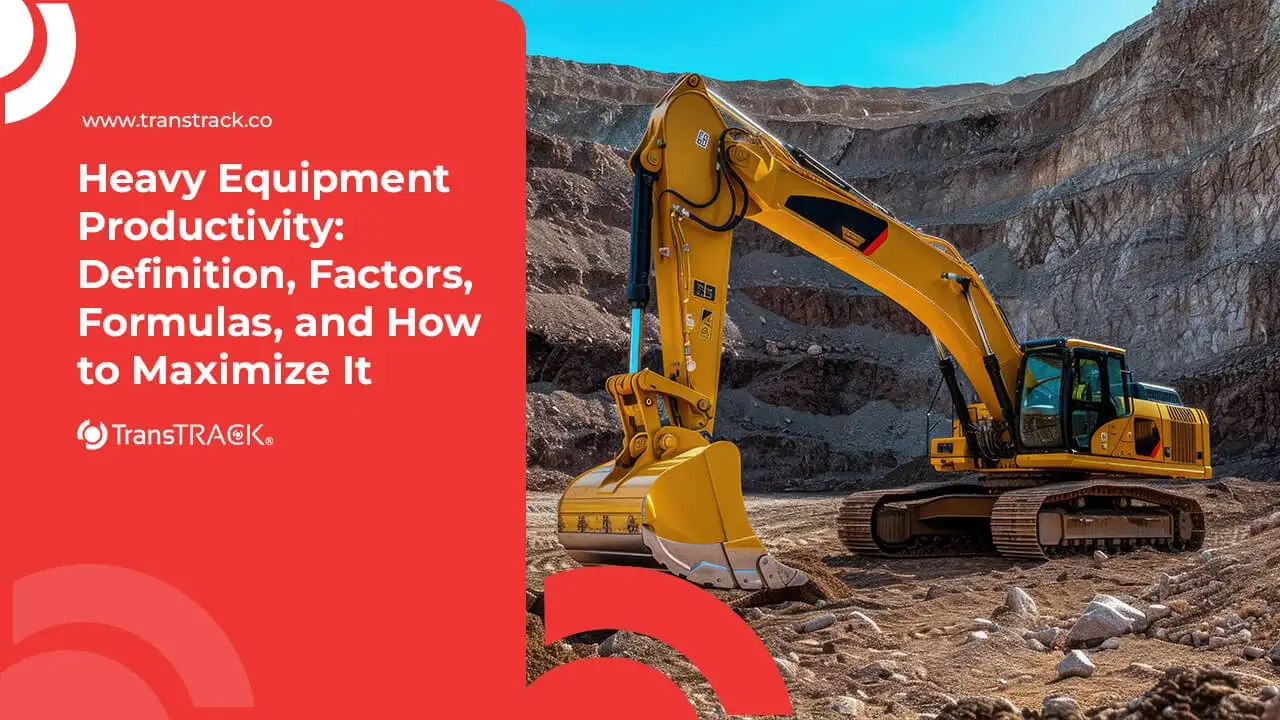
Heavy equipment productivity is an important indicator of successful operations in construction, mining, plantations, and infrastructure projects. Optimizing the performance of excavators, dump trucks, bulldozers, wheel loaders, and supporting units depends not only on engine capacity but also on cycle time, material and hauling road conditions, operator skills, waiting time, downtime, and coordination between units. Therefore, companies need to monitor and evaluate heavy equipment performance based on actual data to achieve production targets optimally. Learn more with TransTRACK!
What Is Heavy Equipment Productivity?
Heavy equipment productivity is the ability of a unit to produce a certain amount of output within a specific period. The output may include the volume of material moved, the number of trips, the area covered, or the amount of work completed per hour.
In mining operations, heavy equipment productivity is generally expressed in the following units:
- Cubic meters per hour or m³/hour.
- Tons per hour or tons/hour.
- Trips per hour or trips per day.
- Kilometers per hour for certain hauling activities.
- Area covered per hour for compaction or grading work.
The greater the output generated using the same amount of time and resources, the higher the productivity of the equipment. However, productivity should also be evaluated in relation to work safety, work quality, fuel consumption, and operating costs.
What Factors Affect Heavy Equipment Productivity?
Heavy equipment productivity is influenced by a combination of technical, operational, human, and environmental factors. The following are some of the main factors that need to be considered.
Bucket Capacity and Heavy Equipment Specifications
The capacity of a bucket, dump body, blade, or other attachment determines the amount of material that can be moved in one work cycle. The larger the capacity, the greater the potential output volume.
However, equipment capacity must be matched with the type of work, material conditions, hauling distance, and capacity of supporting units. An attachment that is too large or too small for the job can reduce efficiency and increase operating costs.
Material Type, Volume, and Characteristics
Material characteristics affect the excavation, loading, and hauling processes. Loose soil is generally easier to excavate than hard rock or compacted material.
Cycle Time or Operational Cycle Duration
Cycle time is the amount of time required for heavy equipment to complete one work cycle. For an excavator, this may include digging, lifting, swinging, dumping, and returning to the initial position.
Work Area and Hauling Road Conditions
Work area conditions directly affect the movement of heavy equipment. Roads with potholes, slippery surfaces, narrow lanes, or steep inclines can increase travel time and the risk of equipment damage.
Heavy Equipment Operator Skills
Operators play an important role in productivity and operational safety. Experienced operators can maneuver more efficiently, position equipment accurately, and avoid unnecessary movements.
Availability, Utilization, Idle Time, and Downtime
Availability indicates the readiness of equipment to operate, while utilization shows how much of the available time is actually used for productive work.
Several indicators that need to be monitored include:
- Availability: The percentage of time the equipment is ready for operation.
- Utilization: The percentage of available time during which the equipment is used.
- Idle time: The period when the engine is running but the equipment is not producing output.
- Downtime: The period when the equipment cannot operate due to breakdowns, maintenance, or other operational issues.
Equipment Condition and Heavy Equipment Maintenance Schedules
Poor equipment condition can reduce productivity and increase the risk of downtime. Problems such as overheating, reduced engine power, hydraulic leaks, damaged tires, or abnormal fuel consumption can disrupt operations.
Coordination Between Excavators, Dump Trucks, and Supporting Units
Productivity also depends on coordination between different equipment units. Too few dump trucks can cause excavators to wait, while too many units can create queues at the loading point.
How Is Heavy Equipment Productivity Measured?
Productivity measurement should use actual data on equipment capacity, cycle time, efficiency, material conditions, and working time. The results can be used to compare performance between units, shifts, work areas, or operating periods.
Basic Heavy Equipment Productivity Formula
The basic heavy equipment productivity formula is:

Where:
Q = heavy equipment productivity.
q = production capacity per cycle.
N = number of cycles per hour.
E = work efficiency in decimal form.
Since the number of cycles per hour is affected by cycle time, the formula can be developed as follows:
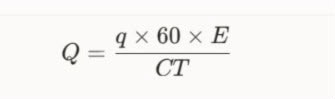
Where:
Q = productivity in m³/hour or tons/hour.
q = material capacity per cycle.
CT = cycle time in minutes.
E = work efficiency in decimal form.
Productivity Formula Based on Capacity, Cycle Time, and Work Efficiency
For loading equipment such as excavators, the following formula can be used:
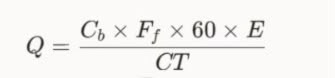
Where:
Q = excavator productivity.
Cb = bucket capacity in m³.
Ff = bucket fill factor.
E = work efficiency.
CT = cycle time in minutes.
If a correction factor is included, the formula becomes:
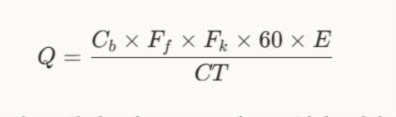
The correction factor Fk may include excavation depth, swing angle, material conditions, operator skill, and work area conditions.
Heavy Equipment Productivity Formula per Hour
If cycle time is expressed in seconds, the productivity formula can use 3,600 seconds per hour
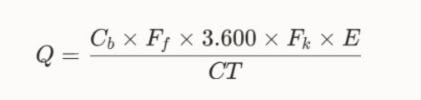
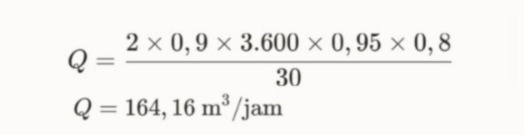
Example:
– Bucket capacity: 2 m³.
– Fill factor: 0.9.
– Cycle time: 30 seconds.
– Work efficiency: 0.8.
– Correction factor: 0.95.
The calculation is:
Correction Factors in Heavy Equipment Productivity Calculations
Correction factors are used to make calculations more representative of actual operating conditions. These factors may include:
- Material factor.
- Bucket fill factor.
- Excavation depth factor.
- Swing angle factor.
- Road condition factor.
- Weather factor.
- Operator skill factor.
- Equipment condition factor.
- Effective working time factor.
- Loading and dumping factor.
Work efficiency can also be calculated by comparing effective working time with available working time:
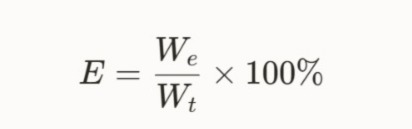
Where:
E = work efficiency.
We = effective working time.
Wt = available working time.
How Can Heavy Equipment Productivity Be Maximized?
Improving heavy equipment productivity requires a comprehensive approach. Companies should not simply add more units, but also optimize working time, coordination, maintenance, operator performance, and field conditions.
Reduce Idle Time and Equipment Waiting Time
Idle time can be reduced by identifying the main reasons equipment stops without generating output. Companies can monitor whether units are waiting because of queues, insufficient material, work instructions, operator changes, or technical problems.
Actions that can be taken include:
- Balancing the number of loading and hauling units.
- Coordinating work schedules between units.
- Responding quickly to operational disruptions.
- Establishing waiting-time standards.
- Analyzing idle time by unit and shift.
Optimize Excavator and Dump Truck Cycle Time
Cycle time can be improved by reducing unnecessary movements and optimizing the layout of the work area. For excavators, equipment position and swing angle can affect loading speed. For dump trucks, hauling distance, road conditions, and maneuvering time affect the entire cycle.
Recommended measures include:
- Positioning dump trucks correctly during loading.
- Reducing the excavator swing angle.
- Improving hauling road surfaces.
- Optimizing loading and dumping point locations.
- Reducing queues in the work area.
- Using actual data to compare cycle time between units.
Adjust Fleet Matching Between Loading and Hauling Equipment
Fleet matching aims to balance loading equipment capacity with the number of hauling units. An imbalance can cause one type of equipment to wait.
Fleet matching evaluations should use cycle time, equipment capacity, trip numbers, waiting time, and production volume data.
Implement Preventive Maintenance to Reduce Downtime
Preventive maintenance is performed before equipment failure occurs. It may include inspections of oil, filters, hydraulic systems, tires, electrical systems, cooling systems, and components with a defined service life.
Improve Operator Competence and Compliance
Operators need to understand operating procedures, safety requirements, fuel efficiency, and proper equipment handling. Competency programs may include technical training, simulations, field coaching, and data-based performance evaluations.
Optimize Hauling Roads, Loading Points, and Dumping Points
Well-maintained hauling roads can shorten travel time and reduce the workload on equipment. Site managers should ensure that roads have suitable width, gradients, drainage, and surface density.
Control Heavy Equipment Fuel Consumption
Fuel consumption can be used as an additional indicator for evaluating heavy equipment productivity. A unit with high fuel consumption but low output should be analyzed further.
The Role of a Fleet Management System in Heavy Equipment Productivity
A fleet management system helps companies collect, monitor, and analyze heavy equipment data on a single platform. This data can be used to understand operational conditions more quickly and accurately.
With the right configuration and integration, a fleet management system can help monitor trips, unit activities, and operational indicators related to production output.
Monitor Equipment Location, Operating Hours, and Status in Real Time
A fleet management system can help monitor the location and status of heavy equipment in real time. Available information may include:
- Unit location.
- Vehicle speed.
- Moving or stationary status.
- Operating hours.
- Engine hours.
- Operating area.
- Geofencing.
- Activity start and end times.
Analyze Idle Time, Downtime, and Operational Cycle Time
Historical data can be used to analyze the causes of unproductive time. Companies can identify when idle time increases, which units experience the most downtime, and which areas cause longer cycle times.
Monitor Trips and Production Output per Unit
The number of trips can be used as one indicator of hauling equipment productivity. By recording trip counts and load volumes, companies can compare unit performance more objectively. Companies can then determine whether production targets were achieved through improved efficiency, additional equipment, or longer operating hours.
Identify Bottlenecks Through an Operational Dashboard
An operational dashboard presents data through indicators, charts, and reports that are easier to understand. Through a dashboard, managers can identify bottlenecks or obstacles in the work process.
Early identification enables teams to take corrective action before operational obstacles have a greater impact on production targets.
Make Data-Driven Decisions to Improve Productivity
Operational data helps companies make more measurable decisions. For example, companies can determine whether they need to add dump trucks, improve hauling roads, change maintenance schedules, or provide additional operator training.
A fleet management system can also be used to:
- Compare unit performance.
- Set maintenance priorities.
- Evaluate operating costs.
- Reduce idle time.
- Improve the accuracy of production reports.
- Optimize fleet utilization.
- Develop productivity improvement strategies.
Conclusion
Heavy equipment productivity is influenced by equipment capacity, material characteristics, cycle time, work efficiency, hauling road conditions, operator skills, availability, idle time, downtime, maintenance, and coordination between units. Productivity can be improved by reducing waiting time, optimizing fleet matching and hauling routes, implementing preventive maintenance, improving operator competence, and controlling fuel consumption.
A fleet management system helps companies monitor the location, status, operating hours, trips, cycle time, idle time, and output of each unit more accurately. Want to optimize the performance of your heavy equipment and fleet? Visit TransTRACK to learn more about Fleet Management System, vehicle monitoring, and operational analytics solutions.

FAQ
What Is Productivity in Mining?
Mining productivity is the ability of equipment, workers, or an operational system to produce output within a specific period. Output may include the volume of material moved, tonnage, number of trips, or production per hour.
For mining equipment, productivity is influenced by equipment capacity, cycle time, work efficiency, material conditions, operator performance, hauling roads, availability, and coordination between units.
What Is the Productivity of an Excavator per Hour?
Excavator productivity per hour varies depending on bucket capacity, fill factor, cycle time, work efficiency, correction factors, material type, and work area conditions. Therefore, there is no single productivity figure that applies to every excavator.
The general formula is: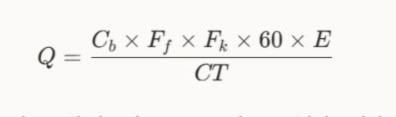
For example, an excavator with a 2 m³ bucket, a 0.9 fill factor, a 30-second cycle time, a 0.95 correction factor, and 0.8 work efficiency has an estimated productivity of approximately 164.16 m³/hour. Actual results may vary depending on field conditions, waiting time, material characteristics, and operator skills.
What Data Is Needed to Calculate Excavator Productivity?
The following data is required to calculate excavator productivity:
– Bucket capacity.
– Bucket fill factor.
– Cycle time.
– Work efficiency.
– Correction factor.
– Material type and characteristics.
– Effective working hours.
– Waiting time or delay time.
– Work area conditions.
– Number of cycles or trips.
– Actual material volume.
These data should be collected consistently by unit and operating period. This allows companies to compare productivity between units and identify the reasons for differences between theoretical productivity and actual output.
Recent Post





Topic :