Bahasa Indonesia

Mining Safety Guidelines to Prevent Accidents
Posted on September 30, 2026 by Nur Wachda Mihmidati
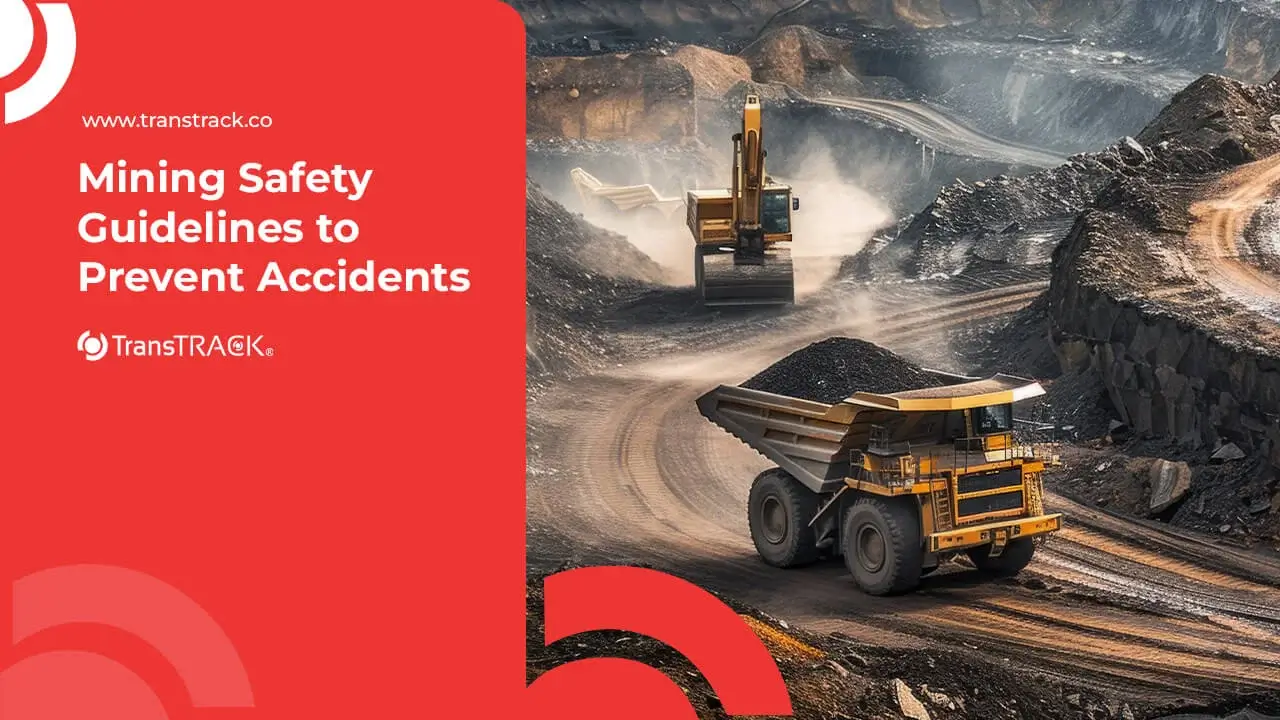
Mining workplace safety is a series of measures designed to prevent accidents, protect workers, and ensure mining operations are conducted safely in accordance with occupational safety and health (K3) standards. Its implementation includes risk identification, hazard control, worker training, and the use of technologies such as fatigue monitoring, Vehicle Surveillance Systems, and Fleet Management Systems to enhance safety in real time. Read the full explanation in the following article TransTRACK!
The Foundations of Workplace Safety in Modern Mining
Occupational safety and health (OSH) in modern mining must be established through a comprehensive approach, rather than relying solely on the use of personal protective equipment. There are three main pillars that complement one another: People, Process, and Technology/Equipment.
- People: Building a culture of occupational safety and health through regular training, raising awareness of potential hazards, and ensuring compliance with competency standards and occupational safety, health, and environmental (K3HSE) regulations. Workers need to understand the risks in their work areas and be able to take appropriate action before an incident occurs.
- Process / System (Process): Implementing strict SOPs, risk identification and management, incident reporting and investigation, and compliance with government regulations such as the ESDM Ministerial Decree. A structured occupational safety and health (OSH) system helps ensure that all mining activities are conducted in accordance with safety standards.
- Technology & Equipment: Utilizing physical safeguards, smart PPE, sensors, monitoring systems, and automation technology to detect and mitigate potential hazards. Technology can provide real-time visibility into operational conditions, enabling preventive actions to be taken more quickly.
4 Steps for Mining Safety
Implementing workplace safety in the mining industry requires a systematic and ongoing process. The following four steps can serve as the foundation for identifying risks, preventing accidents, and improving occupational safety and health (OSH) performance in mining areas.
- Hazard Identification & Risk Assessment (Risk Assessment) E The first step is to identify the various potential hazards that may arise during mining activities, including physical, chemical, mechanical, and environmental hazards. Afterward, each risk is assessed based on its likelihood and impact to determine the priority of control measures.
- Risk Control & Implementation of SOPs (Risk Control) Identified risks must be controlled using the hierarchy of hazard control, starting with elimination, substitution, engineering controls, administrative controls, and ending with the use of PPE. Consistent implementation of SOPs ensures that every activity is carried out in accordance with safe work procedures.
- Continuing Education & Training (Training & Awareness) E E Workers’ competencies and awareness must be strengthened on a regular basis through P5M (5-Minute Talks), OHS induction, toolbox meetings, and emergency response simulations. Continuing training helps workers identify hazards and understand the actions they should take under both normal and emergency conditions.
- Periodic Monitoring, Evaluation, and Audits (Audits and Continuous Improvement) The implementation of occupational safety and health (OSH) must be monitored and evaluated periodically through equipment inspections, observations of working conditions, incident reporting, and safety data analysis. The results of these evaluations and audits can be used to identify gaps in the OSH system and implement continuous improvements.
Technological Innovations to Improve Mine Safety
Technological advancements enable mining companies to improve workplace safety by shifting from a previously reactive approach to a preventive and data-driven one. The integration of AI, IoT, sensors, drones, and wearable devices can help detect potential hazards earlier, monitor workers’ conditions, and provide real-time alerts.
AI Telematics & Fatigue Monitoring System
AI Telematics integrates vehicle data, driver behavior, and operational conditions to help identify safety risks. Meanwhile, the Fatigue Monitoring System uses cameras and AI to detect signs of fatigue, drowsiness, distraction, or loss of focus in drivers.
When a risky situation is detected, the system can issue real-time alerts so that drivers and supervisors can take action before an accident occurs.
IoT Sensor & Proximity Detection System (PDS)
IoT sensors can be used to monitor various operational parameters, such as vehicle location, equipment status, temperature, pressure, and environmental conditions. This data can be transmitted in real time to a monitoring system to help operational teams identify abnormal conditions.
Meanwhile, the Proximity Detection System (PDS) helps detect the presence of workers, vehicles, or heavy equipment within a dangerous range. The system can issue a warning when two objects are at risk of a collision, thereby minimizing the risk of accidents in the operational area.
Visual and Automatic Gas Sensor Drones for Underground Mines
Drones can be used to conduct visual inspections of mining areas that are difficult or risky for workers to access directly. Equipped with specific cameras and sensors, drones can help monitor the condition of slopes, work areas, mining infrastructure, and locations that require periodic inspections.
In underground mines, automatic gas sensors can be used to monitor the presence of hazardous gases and changes in air quality. Data from the sensors enable the system to issue warnings more quickly when environmental parameters exceed safe limits.
Wearable Smart Device & GPS Tracking
Wearable smart devices—such as smart helmets, smart vests, or tracking devices—can help monitor the location and activities of workers in mining areas. With the support of GPS or other positioning technologies, companies can track workers’ locations in real time, especially in high-risk areas.
Wearable technology can also be developed to monitor environmental conditions around workers and provide early warnings when hazardous situations are detected. Integrating this data with the command center helps speed up the response to emergencies while improving visibility into worker safety.
Specific Challenges and Occupational Safety and Health Solutions in Coal Mining
Coal mining operations involve complex safety risks, ranging from the use of heavy equipment to working conditions. Therefore, the implementation of occupational safety and health (OSH) must be supported by robust procedures and real-time monitoring technology.
1. Heavy Equipment Accident Risks
The operation of dump trucks, excavators, and other heavy equipment carries risks such as collisions, blind spots, and vehicle rollovers. The solution is for companies to use ADAS, Driver Monitoring Systems (DMS), Proximity Detection Systems (PDS), and Fleet Management Systems to monitor vehicles and detect potential hazards.
2. Fatigue dan Human Error
Long working hours and grueling operating conditions can impair an operator’s concentration. An AI-based Fatigue Monitoring System can help detect signs of drowsiness, distraction, and loss of focus, allowing warnings to be issued before an incident occurs.
3. Exposure to Dust and Hazardous Gases
Mining operations can generate dust and potentially expose workers to certain hazardous gases. IoT environmental sensors can be used to monitor air quality and environmental conditions in real time and issue alerts when parameters reach unsafe levels.
4. Condition of Mine Roads
Slippery, damaged, or uneven roads can increase the risk of vehicles skidding and rolling over. Monitoring via telematics and GPS can help identify risky driving behaviors, such as speeding and sudden braking, while also pinpointing areas that require attention.
5. Limitations in Monitoring and Emergency Response
The vast size of mining areas makes manual monitoring less effective, especially during emergencies. Centralized monitoring, GPS tracking, geofencing, and panic buttons can help teams locate vehicles or workers and speed up their response to incidents.
Conclusion
Mining safety is a fundamental aspect that must be an integral part of every operational activity. Effective implementation of occupational safety and health (OSH) requires a combination of worker competence, strict adherence to procedures, risk management, and technological support to detect and prevent potential hazards more quickly.
Amid the operational complexities of mining, technology can help companies improve real-time visibility into vehicles, driver behavior, and operational conditions. Vehicle Surveillance System and Fleet Management System from TransTRACK can serve as solutions to support fleet monitoring, improve driving safety, and help companies optimize data-driven mining operations.
Improve safety and operational visibility at your mine with TransTRACK. Discover how our Vehicle Surveillance System and Fleet Management System solutions can help create safer, more controlled, and more efficient mining operations.
FAQ
Why is fatigue monitoring technology so crucial in coal mines?
Fatigue monitoring is important because fatigue can impair concentration, slow reaction times, and increase the risk of human error when operating heavy equipment. AI-based technology can detect signs of drowsiness or distraction and issue real-time alerts before these conditions lead to an incident.
How does the Proximity Detection System (PDS) work on mining heavy equipment?
The Proximity Detection System (PDS) uses devices or sensors to detect the presence of vehicles, heavy equipment, or workers in the surrounding area. When an object enters a risk zone, the system can issue a warning to the operator so that preventive measures can be taken to reduce the risk of a collision.
Is the implementation of mining occupational safety and health (OSH) technology expensive for medium-sized companies?
The cost of implementing occupational safety and health (OSH) technologies depends on the type of technology, the size of the fleet, and the scale of operations. Companies can implement these technologies in phases, starting with the areas or activities that pose the highest risks. This investment should also be viewed in terms of its long-term benefits, such as reducing accidents, downtime, asset damage, and operating costs.
What are the main regulations governing workplace safety in the mining industry in Indonesia?
Mining safety in Indonesia is governed by various regulations, including Law No. 3 of 2020 on Mineral and Coal Mining, Law No. 1 of 1970 on Occupational Safety, as well as technical regulations from the Ministry of Energy and Mineral Resources (ESDM), such as ESDM Ministerial Regulation No. 26 of 2018 on the implementation of good mining practices and the supervision of mineral and coal mining.
Recent Post





Topic :