Bahasa Indonesia

Export-Import Logistics: Definition, Characteristics, Fleet Challenges & TransTRACK’s Technology Solutions
Posted on September 17, 2026 by Nur Wachda Mihmidati
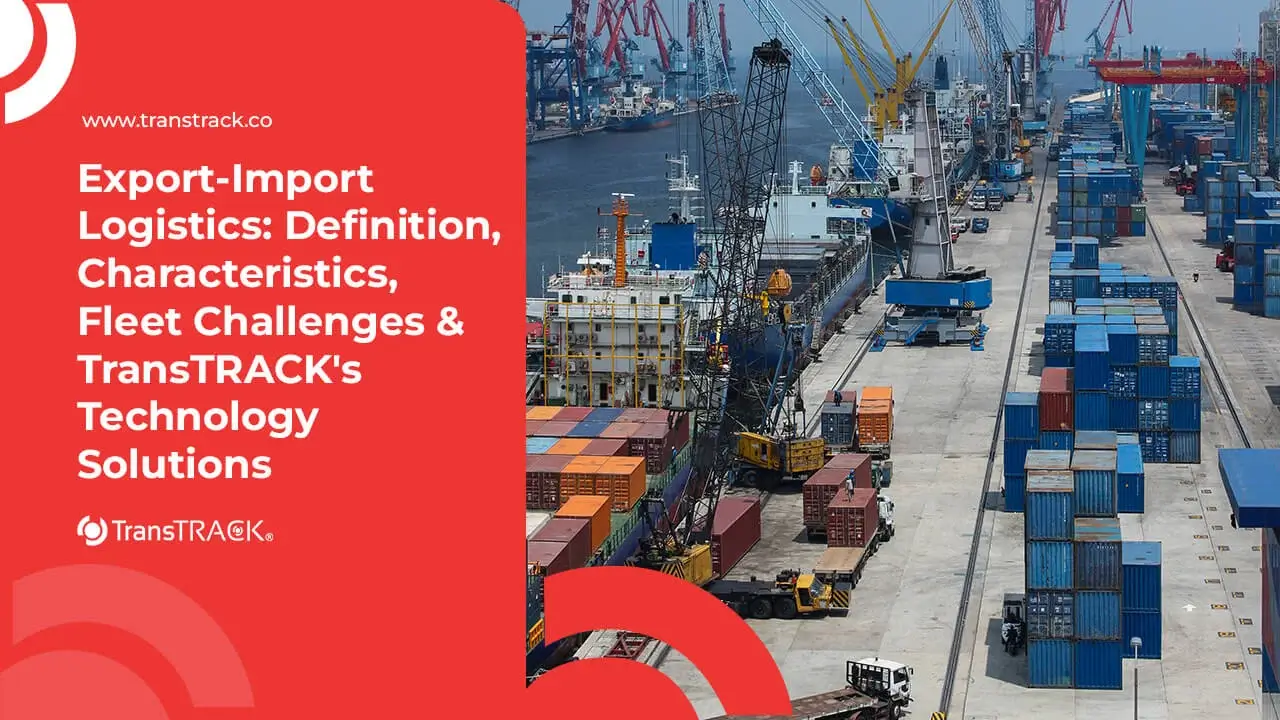
Amid continuous growth in global trade, export-import logistics has become essential for businesses seeking to expand into international markets. However, cross-border supply chains face various challenges, including customs regulations, port congestion, and cargo damage risks. Therefore, logistics and supply chain companies in Indonesia need to understand the characteristics of export-import logistics and leverage technology to improve efficiency and customer satisfaction. Read more with TransTRACK!
Definition and Scope of Export-Import Logistics
Export-import logistics is the process of planning, implementing, and controlling the flow of goods, information, and documents from one country to another to meet international trade requirements.
The scope of export-import logistics includes:
- Multimodal transportation (land, sea, air) across national borders.
- Document management (commercial invoice, packing list, bill of lading, certificate of origin).
- Customs compliance (customs clearance, HS code classification, duty & tax payment).
- Warehouse & distribution management in origin and destination countries.
- Cargo insurance and risk mitigation during transit.
- Coordination with freight forwarders, shipping lines, and local logistics agents.
Unlike domestic logistics, export-import logistics faces regulatory complexity, currency variations, language barriers, and differing compliance standards across jurisdictions.
Key Characteristics of Export-Import Logistics Business
Export-import logistics business has unique characteristics that distinguish it from domestic logistics operations:
- Longer distances and transit times, involving multi-leg transportation and uncertain transit times.
- More complex documentation with varying requirements per destination country.
- Higher risks related to cargo damage, loss, delays, and force majeure.
- Greater variable costs, including demurrage, detention, storage, and currency exchange fluctuations.
- Strict regulatory compliance regarding export-import rules, trade sanctions, and cargo security standards (e.g., ISPS Code, C-TPAT).
- Limited visibility due to involvement of multiple parties (shipper, forwarder, carrier, customs broker, consignee).
These characteristics demand more sophisticated, integrated, and real-time data-driven fleet management and supply chain systems.
Biggest Challenges in Modern Export-Import Fleet Management
Fleet management for export-import logistics faces operational pressures far more complex than domestic logistics. Here are the five main challenges most frequently faced by industry players:
Customs & Compliance Regulatory Barriers
Regulatory complexity is the biggest source of risk in export-import operations. Each country has different document requirements, HS code classifications, and customs clearance procedures.
Impacts:
- Port delays due to incomplete or non-compliant documentation.
- Additional costs such as storage, demurrage, and penalties.
- Risk of goods being held or even returned to origin country.
- Trade sanctions for violating embargo or restricted goods regulations.
Limited Cross-Border Supply Chain Visibility
Export-import supply chains involve multiple parties and transportation modes, resulting in fragmented visibility.
Problems that arise:
- No real-time tracking of cargo position at each journey leg.
- Inaccurate ETA/ETD information, complicating warehouse and distribution planning.
- Slow communication between shipper, forwarder, carrier, and consignee.
- Difficulty identifying bottlenecks causing delays.
Impact: Increased operational costs, decreased customer satisfaction, and inflated demurrage/detention risks.
Operational Cost & Fuel Price Fluctuations
Indonesia’s logistics costs remain around 23–24% of GDP, far above the global average. Fuel price fluctuations, currency exchange rates, and toll tariffs pose major financial challenges.
Triggering factors:
- Diesel/Bio B30 price increases directly hitting operational margins.
- Unpredictable changes in toll and port tariffs.
- Demurrage & detention costs due to port delays.
- Increasing cargo insurance premiums for certain high-risk routes.
Route Uncertainty & Port Congestion
BPS data records Jakarta’s congestion rate reached 53% in 2023, with over 60% of the national truck fleet aged above 10 years. This condition worsens route and transit time uncertainty.
Port congestion impacts:
- Long queues at port gate in/out.
- Swollen dwelling times, increasing operational costs.
- Longer and more expensive alternative routes due to road closures or traffic management.
- ETA uncertainty disrupting customer delivery schedules.
Cargo Security and Damage Risks
Risk of damage or loss during long-distance shipping poses a serious threat, especially for high-value or sensitive cargo (food, pharmaceuticals, electronics).
Risk factors:
- Poor road conditions and aging fleets increasing accident potential.
- Cargo theft at vulnerable points (rest areas, isolated routes).
- Uncontrolled temperature & humidity for cold chain cargo.
- Improper handling during port loading/unloading.
Technology Solutions for Export-Import Fleet Optimization
To overcome the challenges above, export-import logistics companies need to adopt integrated technology solutions that enhance visibility, efficiency, and operational compliance.
IoT Integration & Fleet Telematics System (FMS)
IoT-based Fleet Management System (FMS) provides total control over the entire fleet from a centralized dashboard.
Key capabilities of modern FMS:
- Live GPS tracking of every vehicle in real-time.
- Vehicle condition monitoring: speed, idle time, fuel consumption, engine temperature.
- IoT sensors for cargo: temperature, humidity, shock, tilt.
- Automatic alerts for route deviations, over-speeding, or critical cargo conditions.
- Telematics hardware integration for accurate vehicle data.
Benefits:
- Reduced cargo damage risk through real-time condition monitoring.
- Fuel consumption reduction of 15–20% through more efficient driving behavior.
- Improved fleet utilization with measurable performance data.
Document Automation with TMS & Logistics ERP
Transportation Management System (TMS) integrated with logistics ERP enables automation of export-import documents, from purchase order to bill of lading.
Key features:
- Auto-generate documents (invoice, packing list, DO, BL) from single data input.
- Integration with customs platforms for e-Submission and clearance status tracking.
- Digital approval workflows to reduce manual errors.
- Complete audit trails for compliance and troubleshooting.
Impact:
- Reduced delays from incomplete or incorrectly input documents.
- Faster customs clearance and port gate in/out processes.
- Lower administrative costs and human error risks.
Smart Route Optimization
AI-powered route optimization helps determine the most efficient routes based on traffic data, cost priorities, and delivery schedules.
Advantages of intelligent systems:
- Multi-stop optimization algorithms considering vehicle capacity, delivery times, and road conditions.
- Dynamic rerouting during traffic jams, accidents, or road closures.
- Predictive ETA based on historical data and real-time traffic.
- Telematics integration for monitoring actual vs. planned routes.
Results:
- Transit time reduction up to 40%.
- Lower fuel and toll costs.
- Improved on-time delivery rates and customer satisfaction.
Conclusion
Export-import logistics faces various challenges, from customs regulations and limited supply chain visibility to cost fluctuations, port congestion, and cargo security risks. Therefore, integrated management systems and technologies such as IoT, Fleet Management System (FMS), Transportation Management System (TMS), and smart route optimization are essential to improve efficiency, control costs, and maintain company competitiveness in the global logistics market.
Want to learn more about digital transformation in the logistics industry? Discover various insights, technology trends, and solutions to optimize logistics operations at Logistic Industry with TransTRACK.
FAQ
What are the main barriers that often cause export-import fleet delays at ports?
Main barriers include:
– Incomplete or non-compliant customs documentation.
– Long queues at gate in/out due to port congestion.
– Time-consuming physical cargo inspections.
– Duty & tax payment issues or delayed authority approvals.
– Limited vessel slots or unsynchronized shipping line schedules.
How does IoT technology help reduce export-import cargo damage risks?
IoT enables real-time cargo condition monitoring through temperature, humidity, shock, and tilt sensors.
Benefits:
– Early alerts when cargo conditions exceed safe thresholds.
– Forensic data for insurance claim investigations.
– Optimized handling based on transportation behavior data.
– Cold chain monitoring for temperature-sensitive cargo.
What is the difference between domestic and export-import logistics?
Export-import logistics has higher complexity compared to domestic logistics, particularly in the following aspects:
– Distance & time: Export-import shipments are typically longer, involve multiple stages (multi-leg), and have harder-to-predict arrival times.
– Documentation & regulations: Export-import processes require more complex documentation and compliance with regulations across multiple jurisdictions and customs authorities.
– Costs: Operational costs are more volatile due to exchange rates, import duties, and demurrage fees.
– Visibility: Tracking is more complex due to multiple supply chain parties involved, leading to fragmented visibility.
– Risks: Risks of damage, loss, and cargo delays are generally higher during cross-border shipping processes.
Why do demurrage costs pose a financial challenge for export-import logistics businesses?
Demurrage is a fee charged when containers are not returned or picked up within the time specified by the shipping line or port.
Causes of inflated demurrage costs:
– Customs clearance delays due to documentation issues.
– Port congestion extending dwelling time.
– Distribution delays from port to consignee warehouse.
– Schedule mismatches between vessels, trucks, and warehouses.
Impact: Eroded operational margins, disrupted cash flow, and decreased customer satisfaction.
Recent Post




Topic :