Bahasa Indonesia

What Are Autonomous Vehicles? Levels, Technologies, and Their Impact on Logistics
Posted on September 21, 2026 by Nur Wachda Mihmidati
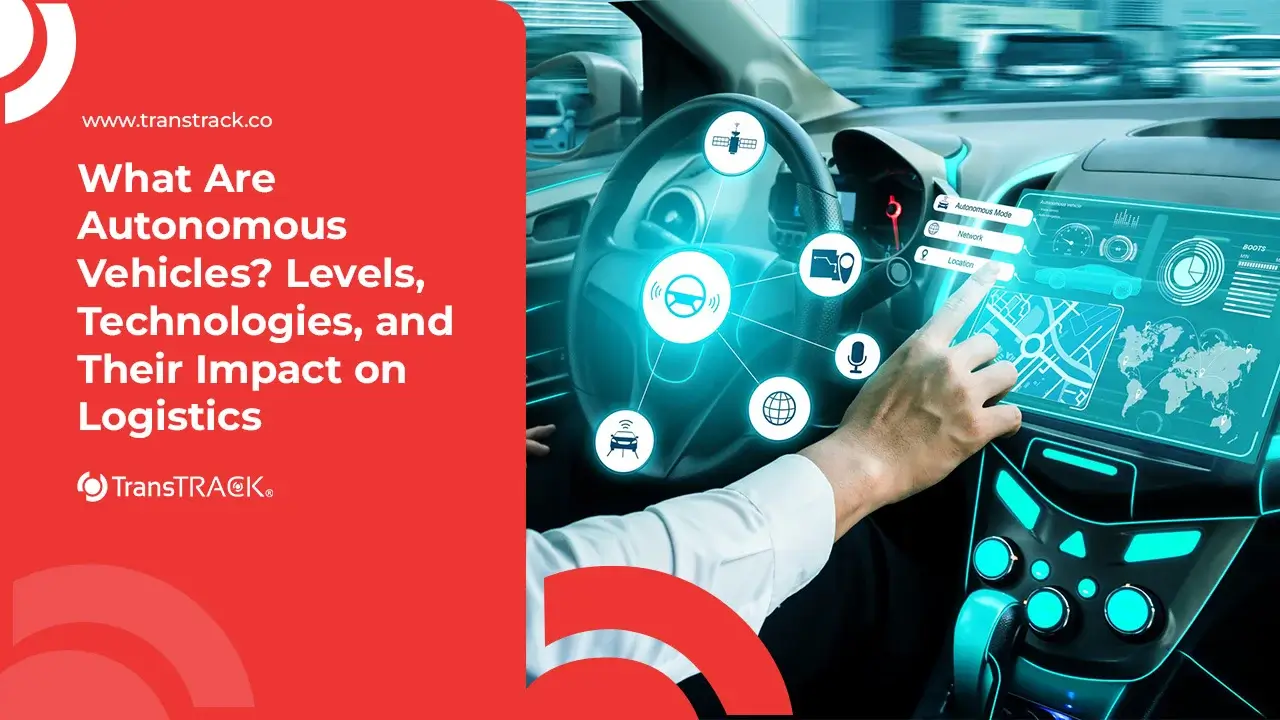
Amid growing demands for digitalization and operational efficiency, autonomous vehicles have emerged as a disruptive technology in the logistics and transportation sectors. This technology has the potential to reduce dependence on human drivers, cut accidents caused by human error, and boost fleet productivity and efficiency. Explore the autonomous vehicle ecosystem from SAE J3016 automation levels and sensor technologies to AI, V2X, and the real-world benefits and implementation challenges with TransTRACK!
What Are Autonomous Vehicles?
An Autonomous Vehicle is a vehicle designed to perform various driving functions independently, such as steering, acceleration, and braking. These capabilities are enabled by a combination of sensor technologies, artificial intelligence (AI), and data connectivity. The goal is to reduce reliance on human drivers while improving safety, operational efficiency, and opening new opportunities for the logistics and commercial transportation industries.
In the logistics sector, autonomous vehicles can lower operational costs, minimize human error risks, and increase fleet utilization. Under certain routes and conditions, this technology even enables vehicles to operate for extended periods, supporting up to 24-hour operations.
6 Levels of Vehicle Automation (SAE J3016 Standard)
The SAE J3016 standard classifies vehicle automation into 6 levels based on who controls the driving task, who monitors the environment, and who serves as the fallback if the system fails.
Level 0 (No Driving Automation)
Full control remains with the human driver. The system only provides occasional warnings (e.g., blind spot warning) without automatic intervention.
Level 1 (Driver Assistance)
Single features such as Adaptive Cruise Control (ACC) or lane keeping assist control either speed or steering, but not both simultaneously. The driver remains fully responsible.
Level 2 (Partial Automation)
Steering and acceleration/braking operate automatically together, but the driver must continuously monitor the road and be ready to take over at any time. Example: autopilot features in some consumer cars.
Level 3 (Conditional Automation)
The system takes full control under specific conditions (e.g., highways with clear lane markings). The driver may disengage attention but must be ready to intervene when the system requests.
Level 4 (High Automation)
The vehicle drives itself within defined areas or routes (ODD – Operational Design Domain) without driver intervention. Suitable for autonomous shuttles, logistics trucks on specific corridors, or port operations.
Level 5 (Full Automation)
Full self-driving capability in all terrains and weather conditions without a physical steering wheel. No driver is needed; the vehicle handles all scenarios like a human.
Autonomous Vehicle Technology Ecosystem
Autonomous vehicles do not operate in isolation; they result from integrating three main pillars: perception (sensors), cognition (AI/ML), and connectivity (V2X).
Key Sensor Combination (Autonomous Vehicle Sensors)
Autonomous vehicles rely on sensor fusion to “see” and understand the environment in 360°. Three core sensors commonly used:
- LiDAR (Light Detection and Ranging): Emits laser pulses to create high-resolution 3D maps (accuracy ±2–5 cm). Advantage: precise geometry; disadvantage: performance drops in extreme weather and relatively high cost.
- RADAR (Radio Detection and Ranging): Uses radio waves to measure object distance and speed. Advantage: weather-resistant, directly measures speed via Doppler effect; disadvantage: low spatial resolution.
- Camera: Captures visual images for object classification (signs, traffic lights, pedestrians). Advantage: rich semantic information and low cost; disadvantage: sensitive to glare, low light, and does not directly measure depth.
The best approach is sensor fusion that combining LiDAR, RADAR, and cameras to compensate for each other’s weaknesses.
Vehicle Brain: AI, Machine Learning & Edge Computing
Raw sensor data must be processed in real-time for object detection, behavior prediction, and decision-making. This is where AI and machine learning come in:
- Perception: Identifying objects (vehicles, pedestrians, signs) from sensor data.
- Prediction: Estimating trajectories of objects around the vehicle.
- Planning & Control: Determining routes, speed, and safe maneuvers.
Edge computing enables on-board data processing for low latency, crucial at high speeds or in dynamic conditions.
Range and Connectivity (V2X – Vehicle-to-Everything)
V2X is connectivity between the vehicle and other elements: other vehicles (V2V), infrastructure (V2I), pedestrians (V2P), and networks (V2N). Benefits include:
- Enhanced situational awareness beyond onboard sensor range.
- Support for inter-vehicle coordination (e.g., logistics truck platooning).
- Improved safety through early warnings (collisions, congestion, road conditions).
The main V2X challenge is harmonizing communication standards and evolving regulations.
Key Benefits and Implementation Challenges of Autonomous Vehicles
Key benefits of autonomous vehicle implementation:
- Safety: Reduces accidents caused by human error (fatigue, distraction).
- Operational Efficiency: Optimizes routes, fuel consumption, and fleet utilization, especially in B2B logistics.
- Productivity: Drivers can shift to supervisory roles or perform other tasks when Level 3–4 is active.
- ESG: Potential emission reductions through smoother driving and optimal routing.
Implementation challenges:
- Regulation & Legality: Legal frameworks for testing and commercial operations still vary across jurisdictions.
- Cybersecurity: Connected vehicles are vulnerable to hacking if not properly protected.
- Technology Costs: High-end sensors (LiDAR, 4D radar) and edge computing remain expensive for large-scale deployment.
- Infrastructure Readiness: Road markings, signals, and V2X connectivity need upgrades to support full autonomy.
Conclusion
Autonomous vehicles are no longer just a futuristic concept but an increasingly tangible part of technological advancement in the logistics and transportation industries. With growing implementation opportunities, understanding this technology and embracing digital transformation are critical steps for businesses to remain adaptive and competitive.
Want to dive deeper into technology developments and digital transformation in the logistics industry? Explore the latest insights, trends, and solutions in the Logistics Industry from TransTRACK.
FAQ
What is the main difference between LiDAR and RADAR in autonomous vehicles?
LiDAR uses laser pulses to create high-resolution 3D maps with centimeter-level accuracy, ideal for object geometry and positioning. RADAR uses radio waves, is more weather-resistant, and excels at directly measuring object speed, but has lower spatial resolution.
Are autonomous cars legal for use on public roads?
Some jurisdictions already allow limited testing and operations (e.g., autonomous shuttles or Level 4 trucks on specific routes), but full regulations for Level 5 are still evolving and vary by country.
Why are AI and Machine Learning systems crucial for autonomous vehicles?
AI and ML transform raw sensor data into environmental understanding: detecting objects, predicting behaviors, and making real-time driving decisions. Without AI, sensor data would just be numbers without context.
Are autonomous vehicles completely safe from hacking risks?
Not entirely. Because they are highly connected (V2X, OTA updates, cloud), autonomous vehicles are vulnerable to cyberattacks if not protected with layered security architectures, encryption, and continuous monitoring.
Recent Post




Topic :