Bahasa Indonesia

FMCG Inventory Management Guide to Improve Efficiency
Posted on September 23, 2026 by Nur Wachda Mihmidati
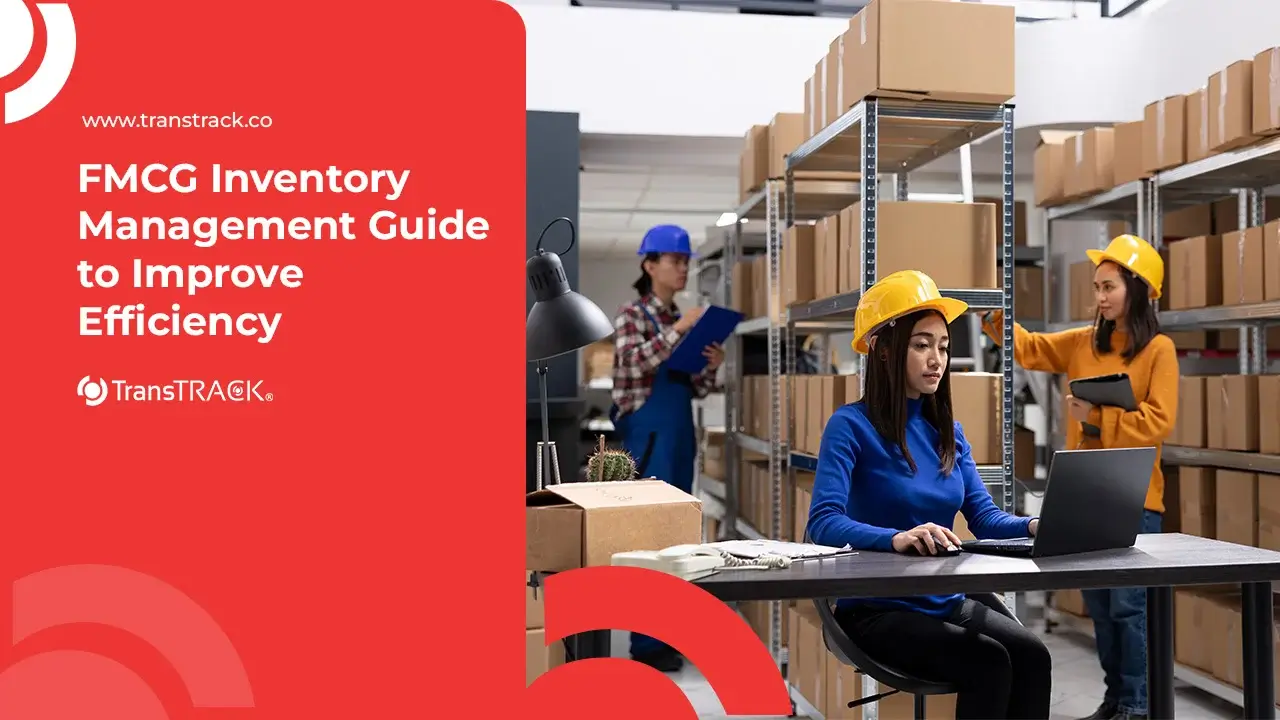
FMCG inventory management is the process of managing product inventory to ensure it remains available to meet market demand, while avoiding overstock and stockouts. Effective management includes demand forecasting, inventory control, monitoring inventory movements, and integration with distribution processes. Read more about it in the following TransTRACK article!
What Is FMCG Inventory Management?
FMCG inventory management is the process of organizing and controlling the inventory of Fast-Moving Consumer Goods to ensure they are available in the right quantities, at the right time, and in the right locations. In general, stock management involves recording incoming and outgoing goods, monitoring inventory, setting minimum and maximum stock levels, and determining the reorder point. Proper management helps companies maintain product availability while reducing the risk of stockouts, overstocks, and unnecessary storage costs.
In the FMCG industry, inventory management is becoming increasingly important because products have high turnover rates and some have limited shelf lives. Companies need to consider sales data, changes in demand, lead times from suppliers, expiration dates, and promotional activities when determining inventory requirements. With effective inventory management, companies can improve warehouse efficiency, maintain product availability, minimize the risk of damaged or expired goods, and support smooth distribution all the way to the point of sale.
Objectives and Benefits of FMCG Inventory Management
The primary goal of FMCG inventory management is to ensure product availability in line with market demand without creating excess inventory. Inventory management helps companies determine the optimal inventory level based on demand, sales velocity, lead time, and storage capacity. As a result, companies can reduce the risk of stockouts, overstocking, and damaged or expired products.
Effective inventory management also offers benefits such as cost efficiency in storage, increased warehouse productivity, more optimal inventory turnover, and smoother distribution. In addition, accurate inventory data can help companies make faster and more precise decisions regarding purchasing, production, and distribution, thereby ensuring consistent customer service.
How to Avoid Overstocking and Stockouts in the FMCG Industry
Avoiding overstock and stockouts requires inventory management that is measured and responsive to changes in demand. The following steps can help FMCG companies maintain optimal inventory levels while supporting smooth operations and distribution.
Creating a Demand Forecast Based on Sales Data
Use historical sales data, demand trends, seasonal patterns, and promotional activities to forecast inventory needs. Accurate forecasts help companies maintain inventory levels that meet market demand and reduce the risk of both overstocking and stockouts.
Determining Safety Stock for Priority Products
Safety stock serves as a reserve inventory to cope with spikes in demand or supply delays. The quantity must be adjusted based on demand levels, lead time, and the product’s importance to ensure it is neither too little nor too much.
Setting the Reorder Point and Minimum Stock Level
The reorder point determines when a company should place a reorder before inventory runs out. Meanwhile, the minimum stock level is the inventory threshold that must be maintained to ensure smooth operations and prevent stockouts.
Monitoring Inventory Levels on a Regular Basis
Conduct regular inventory monitoring to track changes in inventory levels, sales velocity, and products showing unusual movement. Data-driven monitoring also helps companies take action more quickly when inventory begins to approach minimum levels.
Implementing the FIFO or FEFO Method for FMCG Products
FIFO (First In, First Out) ensures that products received first are shipped first. Meanwhile, FEFO (First Expired, First Out) prioritizes products with the nearest expiration date. FEFO is particularly important for FMCG products with a limited shelf life because it reduces the risk of products expiring.
Adjusting Purchase Quantities Based on Product Turnover Rate
Purchase quantities should be adjusted based on inventory turnover and the demand level for each product. Products with high turnover can be ordered more frequently, while products with low turnover should be purchased in more controlled quantities to prevent inventory buildup.
Managing Slow-Moving Products and Products Nearing Their Expiration Date
Periodically identify slow-moving products and products nearing their expiration dates. Companies can adjust their purchasing, redistribute inventory among locations, implement promotional programs, or adopt other sales strategies to prevent inventory from piling up and resulting in losses.
Inventory Management Strategies for the FMCG Industry
FMCG inventory management requires a strategy that balances product availability with cost efficiency. By managing inventory based on product characteristics, demand patterns, and supply chain conditions, companies can reduce the risk of overstock and stockouts while improving inventory turnover.
Classifying Products Using ABC Analysis
ABC analysis helps companies group SKUs based on their value or contribution to sales. Category A products, which make a high contribution, require stricter monitoring and inventory control than Category B and C products.
Integrating Sales, Inventory, and Distribution Data
Integrate sales, warehouse inventory, and distribution data so that the company has a comprehensive view of its inventory. Connected data helps teams track inventory levels and speed up decision-making regarding procurement and distribution.
Adjusting Inventory to Seasonal Trends and Promotional Programs
Demand for FMCG products may increase during certain periods, such as holidays, the vacation season, or during promotional campaigns. Companies need to adjust their inventory levels based on seasonal patterns and estimated increases in demand to ensure that stock remains available without causing a buildup once those periods end.
Determining Inventory Policies for Each SKU
Each SKU has different demand levels, lead times, shelf life, and characteristics. Therefore, companies need to establish specific inventory policies, including minimum stock, maximum stock, safety stock, and reorder points, tailored to the needs of each product.
Conducting Scheduled Inventory Counts
Periodic inventory counts are necessary to ensure that the physical inventory matches the data recorded in the system. Any discrepancies between the physical inventory and the system data must be investigated immediately to avoid disrupting purchasing, storage, and distribution planning.
Implementing Collaboration with Suppliers for Supply Planning
Collaboration with suppliers helps companies align their inventory needs with supply capacity and schedules. Sharing information about demand forecasts, delivery schedules, and changes in demand can help reduce the risk of supply delays and excess inventory.
Mengukur Inventory Turnover dan Stock Accuracy
Inventory turnover is used to measure how quickly inventory is sold and replaced over a specific period, while stock accuracy indicates the degree of consistency between inventory data and physical conditions. These two indicators can be used to evaluate the effectiveness of inventory management and identify areas for improvement.
How to Improve FMCG Inventory Management Efficiency
The efficiency of FMCG inventory management can be improved by leveraging technology to streamline record-keeping processes, enhance data accuracy, and provide visibility into inventory levels. With an integrated system, companies can manage inventory more responsively while supporting purchasing and distribution processes.
Using an Integrated Inventory Management System
An Inventory Management System helps companies manage inventory data centrally, from incoming and outgoing stock to inventory levels at various locations. An integrated system can reduce reliance on manual record-keeping and minimize the risk of data errors.
Automating the Recording of Incoming and Outgoing Goods
Automation allows every incoming and outgoing goods transaction to be recorded directly into the system. This process speeds up inventory updates and reduces errors that can occur due to manual recording.
Implementing Barcodes or QR Codes for Inventory Accuracy
Barcodes and QR codes can be used to identify products and track their movements more quickly. Every step of the process—from receiving and storage to picking and shipping—can be scanned, making inventory data more accurate and easier to track.
Linking Inventory Management with Distribution Planning
Inventory management must be linked to distribution activities so that the company can identify product needs at each location. This integration helps determine delivery priorities, balance inventory across warehouses, and reduce the risk of excess inventory at one location while another location experiences a shortage.
Provides a Dashboard for Real-Time Inventory Monitoring
The real-time dashboard provides visibility into inventory levels and movements without having to wait for manual reconciliation. Information such as available inventory, minimum inventory levels, fast-moving products, and products nearing their expiration dates can be monitored in a single view.
Analyzing Inventory Data to Support Purchasing Decisions
Historical inventory and sales data can be used to determine more appropriate purchase quantities and timing. This analysis helps companies align their procurement with demand patterns, product turnover rates, and inventory levels, resulting in more efficient purchasing decisions.
Conclusion
As a critical component of FMCG operations, inventory management is not only about product availability but also about how inventory can be efficiently integrated into the distribution process. Integrating data on inventory, orders, and distribution activities helps companies improve supply chain visibility and make decisions more quickly and accurately.
To support this process, TransTRACK Logistics Service Integrator helps integrate various logistics activities into a single digital ecosystem. This solution can help companies gain visibility into logistics processes, manage distribution activities, and optimize coordination between processes in a more integrated manner. With the right technological support, FMCG companies can build a more efficient, responsive, and measurable inventory and distribution management system. Optimize FMCG inventory and distribution management with TransTRACK.
FAQ
What Are the Challenges of Inventory Management?
Challenges in FMCG inventory management include rapid changes in demand, the risk of overstock and stockouts, expired products, data inaccuracies, and supply delays. The large number of SKUs and storage locations also makes inventory management even more complex.
How Can You Optimize FMCG Product Inventory?
Inventory can be optimized by creating forecasts based on sales data, determining safety stock and reorder points, and monitoring inventory movements on a regular basis. Implementing an integrated system also helps improve inventory accuracy and visibility.
How Can You Minimize the Risk of Excess Inventory or Overstock?
The risk of overstock can be minimized by adjusting purchase quantities based on inventory turnover rates and product demand trends. Companies also need to monitor slow-moving products and use sales data as the basis for procurement planning.
Recent Post





Topic :