Bahasa Indonesia
Solve Key Problems in Logistics Operations with a Fleet Management System
Posted on December 30, 2025 by Nur Wachda Mihmidati
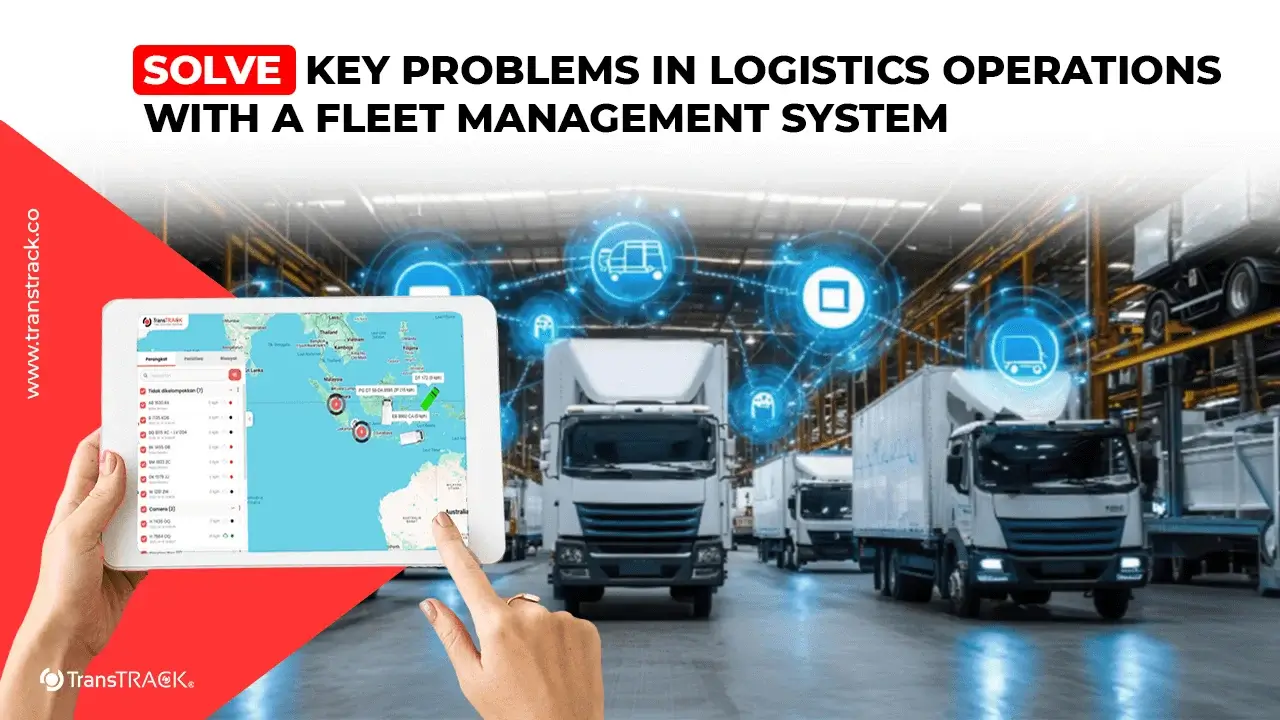
The logistics industry has become the backbone of today’s economy, but logistics operations face increasingly complex challenges, particularly in managing the end-to-end process, which includes procurement, storage, distribution, and final delivery to consumers. System disintegration and a lack of real-time visibility are often the main sources of increased costs and decreased customer satisfaction, resulting in eroded profit margins due to daily inefficiencies. The digitalization process through a Fleet Management System is a bridge to transform pain points into efficiency and profit, and acts as a solution to overcome obstacles. Get to know more in this TransTRACK Article!
Problem Cluster 1: Cost Inefficiency (Cost Control)
Cost inefficiencies in logistics operations directly impact a company’s bottom line. Unexpected expenses resulting from a lack of control over operations and cost allocation can erode profit margins. Here are some examples of problems related to cost inefficiencies and solutions using a Fleet Management System:
Fuel Leaks and Waste
- Problem: Difficulty in monitoring the amount of fuel filled
- Increased potential for undetected theft (diesel fuel)
- Wasteful fuel consumption (excessive idling)
- Solution with FMS: Utilizes the Fuel Monitoring System which is a precise fuel monitoring sensor and automatic idling report.
Unexpected Fleet Maintenance Costs
- Problem: Missed fleet maintenance schedules increase the risk of sudden breakdowns
- Unexpected and large fleet repair costs
- Solution with FMS:Automatic Preventive Maintenance Scheduling by taking into account mileage or engine hours not just the date
Problem Cluster 2: Time Efficiency and HR Performance
The speed and quality of service in logistics operations are significantly influenced by the time efficiency and performance of human resources in the field. Often, the lack of a structured work system and effective monitoring technology leads to decreased performance and time efficiency. Here are some issues related to time efficiency and human resource performance:
Suboptimal and Long Delivery Routes
- Problem:Choosing a longer and less effective route (not according to needs)
- Increased and inefficient travel time
- Increased fuel costs due to suboptimal route selection
- Solution with FMS:Utilizing Route Optimization, an integrated system that can accurately calculate the most optimal route and monitor fleet compliance with predetermined routes.
Subjective and Risky Driver Performance Assessment
- Problem: Difficulty in measuring driver performance objectively
- Unmonitored risky behavior (speeding, harsh braking)
- Increased risk of accidents due to lack of monitoring systems
- Solution with FMS:Utilizing Driver Behavior Monitoring technology that can provide data-based evaluation and assessment and targeted training.
Problem Cluster 3: Lack of Asset Visibility and Security
Lack of asset visibility and security poses a significant obstacle to maintaining operational transparency and protecting cargo and fleets. Without real-time monitoring, companies struggle to detect route deviations, theft, or damage during delivery. Here are some examples of related issues:
Lack of Real-Time Asset Visibility
- Problem: Reliance on manual communication to know location
- Inadequate fleet monitoring system that relies solely on human resources
- Difficulty in knowing the condition of the load
- Solution with FMS: Utilizing Real Time GPS Tracking technology that can provide complete data and full transparency regarding the location and condition of the fleet as well as additional sensors such as temperature sensors for the cold chain.
Time-consuming Turnaround Time
- Problem: Uncertainty of cargo arrival time
- Lack of visibility and adequate systems to know about this
- Distribution vehicles wait too long and cause inefficiencies
- Solution with FMS: Utilizing Real-Time ETA (Estimated Time of Arrival) through Geofencing which can provide companies with full visibility so that loading and unloading teams can be on standby and reduce dwelling time.
Why is the TransTRACK Fleet Management System the Prime Solution for Logistics Operations?
The TransTRACK Fleet Management System offers a premier solution for logistics operations and fleet management, offering a powerful integration that unifies all systems and technologies into a single dashboard. With a data-driven approach, every decision is more accurate and measurable, no longer based solely on assumptions. The system also automatically audits and monitors fleet operations, making TransTRACK’s Fleet Management System an all-in-one solution that improves the efficiency and transparency of logistics operations.
Conclusion
The world of logistics operations is inextricably linked to various challenges, which are increasingly complex and require immediate intervention. Optimizing logistics operations is impossible without addressing fundamental issues such as inefficiency, limited visibility, and data inaccuracy. Through digitalization and the use of integrated systems and technology, companies can implement appropriate and efficient management measures to optimize operations.
Don’t let these challenges continue to eat away at your company’s profit margins—it’s time to digitally transform with TransTRACK’s Fleet Management System to improve your business’s control, efficiency, and profitability.
FAQ
What are some common problems in logistics operations that often occur?
Common issues that arise include late deliveries, inefficient routes, high operational costs, lack of fleet visibility, and poor coordination between field and central teams.
How does FMS help address operational logistics challenges?
FMS provides real-time vehicle tracking, route optimization, driver behavior monitoring, and analytical reports for fast and accurate decision making.
Can FMS help reduce fleet operating costs?
Yes, FMS helps reduce idle time, fuel consumption, and unscheduled maintenance—all of which have a direct impact on fleet cost efficiency.
How many percent of logistics operational costs can be saved with FMS?
Based on the data collected, on average, companies can save around 10-30% on fuel costs and significantly reduce unexpected maintenance costs.
What is the role of FMS in the supply chain?
FMS acts as the “eyes” and “brains” in the distribution and transportation process in the supply chain and ensures that the fleet moves efficiently, safely, and reaches the next party on time.
Recent Post




Topic :