Bahasa Indonesia

Fleet Management System Audit Checklist Before Subscribing
Posted on October 14, 2026 by Nur Wachda Mihmidati
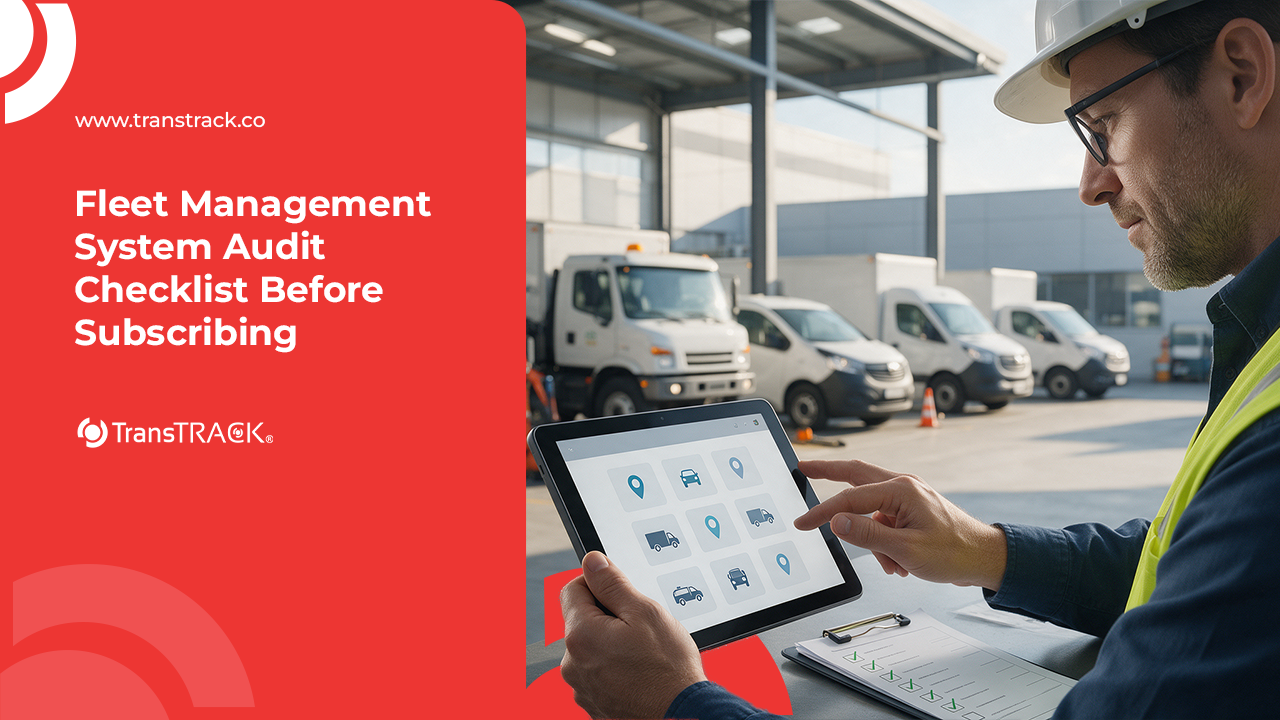
Choosing a Fleet Management System (FMS) isn’t just a matter of comparing subscription prices or the number of features. The system you choose will be used to monitor vehicles, manage drivers, control operations, and process fleet data. Therefore, companies need to conduct a thorough evaluation before deciding to subscribe.
One approach is to use the Fleet Management System audit checklist. The checklist helps companies assess technology readiness, features, security, costs, and vendor services more objectively. Read the full explanation in the following TransTRACK article!
Apa Itu Audit Checklist Fleet Management System?
A Fleet Management System (FMS) audit checklist is a list of criteria used to evaluate an FMS before a company selects and subscribes to a service. This checklist covers aspects such as hardware, software features, data security, integration, legal compliance, costs, and after-sales service.
With a structured checklist, companies can ensure that the selected FMS truly meets their operational needs, rather than simply offering a wide range of features.
The Benefits of Conducting an Audit Before Subscribing to FMS
Conducting an audit before selecting an FMS helps companies reduce the risk of choosing the wrong system. Some of the key benefits include:
- Ensuring alignment with fleet needsThe FMS must be capable of supporting the characteristics of the managed fleet, whether trucks, buses, rental cars, operational vehicles, or heavy equipment.
- Avoiding Hidden CostsCompanies can identify costs related to devices, installation, maintenance, SIM cards, integration, upgrades, and additional features that may not be included in the monthly subscription fee.
- Ensuring Data Security 50 The evaluation should cover how vendors store, transmit, access, and protect location data and fleet operational information.
- Assessing the quality of after-sales support: Technical support, response time, maintenance, and the terms of the Service Level Agreement (SLA) must be confirmed before the contract is signed.
Audit Checklist Before Subscribing to a Fleet Management System
Here are some important aspects that can be included in an FMS audit checklist.
1. Hardware and Sensor Evaluation (Hardware Checklist)
Make sure the equipment you use is appropriate for the condition and needs of your fleet. Some things to check include:
- GPS trackers and location accuracy.
- Device quality and resistance to environmental conditions.
- Availability of additional sensors, such as fuel sensors, temperature sensors, or door sensors.
- The device is capable of operating on various types of vehicles.
- Availability of connectivity and network support.
- A backup system in case the primary connection is disrupted.
- The process of installing, maintaining, and replacing devices.
- Device warranty and claim terms.
For fleets operating in areas with extreme conditions, the devices’ resistance to temperature, water, dust, and vibration must also be taken into account.
2. Software Feature Evaluation (Software & Features Checklist)
Next, evaluate the FMS features based on the company’s operational needs. Some features that generally need to be reviewed include:
- Real-time GPS tracking.
- Geofencing and notifications.
- Monitoring driver behavior.
- Fleet utilization dan vehicle monitoring.
- Fuel monitoring.
- Maintenance management.
- Trip dan route monitoring.
- Trip replay.
- Dashboards and operational reports.
- Mobile application.
- Driver identification.
- Integration with a camera or vehicle safety system.
- The ability to configure the system according to the company’s needs.
Don’t just judge a system by the number of features it has. Make sure those features can actually be used by the operations team and generate information that can aid in decision-making.
3. Data Security & System Integration (Technical & Security Checklist)
Fleet data is a critical part of a company’s operations. Therefore, security and integration must be included in the audit checklist.
Some things to consider:
- How fleet data is stored and protected.
- Access rights are configured based on user roles.
- Account authentication and security mechanisms.
- Backup dan recovery data.
- Availability of an API for integration.
- API documentation and technical support for integration.
- Compatibility with ERP, TMS, WMS, or the company’s internal systems.
- The system’s ability to handle multi-user and multi-fleet requirements.
This evaluation is particularly important for companies that want to integrate FMS with their existing operational systems.
4. Evaluation of Legal Compliance, SLA, and Costs (Commercial & Legal Checklist)
The commercial aspects also need to be reviewed in detail before the contract is drawn up. Make sure the company understands:
- Subscription fees and contract terms.
- Equipment and installation costs.
- Cost of additional features or sensors.
- Integration and API costs, if any.
- Terms and Conditions for Upgrading or Downgrading Services.
- Device warranty.
- SLA dan target uptime.
- Waktu respons customer support.
- Maintenance provisions.
- Contract duration and termination procedures.
- Ownership of and access to data after the contract ends.
That way, companies can calculate the total cost of ownership (TCO), rather than just looking at the monthly plan price.
Steps for Implementing the FMS Audit Checklist
To make the evaluation process more objective, companies can conduct audits in several stages.
First, form an internal evaluation team. Include representatives from operations, IT, and finance. Each team can provide an evaluation based on its own needs and perspective.
Second, conduct a Proof of Concept (PoC) or pilot test. Implement the FMS on several units of the fleet—for example, 2–3 vehicles—to assess the system’s performance under real-world operating conditions.
During the trial period, evaluate tracking accuracy, ease of use, device stability, dashboard quality, notifications, reports, and customer support responsiveness.
Third, use an evaluation matrix. Assign scores to each criterion and compare the results across multiple vendors. Companies can assign greater weight to the most important aspects, such as security, reliability, integration, or after-sales support.
With this approach, the decision to select an FMS is based not only on price or vendor claims, but on measurable evaluation results.
Conclusion
A Fleet Management System audit checklist helps companies ensure that the solution they choose meets their fleet’s needs, is secure, is easy to integrate, and offers transparent pricing and services. Evaluations using the checklist and a proof of concept (PoC) can also help companies make decisions based on system performance, rather than just price or the number of features.
To support more effective fleet management, TransTRACK Fleet Management System offers a solution for monitoring vehicles in real time, optimizing operations, enhancing safety, and managing fleet data—all on a single platform. Discover TransTRACK’s Fleet Management System and get the most out of every trip your fleet takes.
FAQ
What is an audit checklist?
An audit checklist is a list of criteria or questions used to evaluate a system in a structured manner. In FMS, a checklist may cover hardware, software, security, integration, costs, and vendor services.
Why is an audit checklist important before subscribing to a Fleet Management System?
An audit checklist helps companies ensure that the FMS meets their fleet’s needs, understand all costs, evaluate data security, and assess the quality of service and vendors’ SLAs before making a decision.
What is the ideal timeframe for conducting an FMS evaluation or proof of concept (PoC)?
The duration of the PoC depends on the complexity of the fleet and the company’s needs. For an initial evaluation, testing a few units over several weeks can provide insight into the system’s performance under real-world operating conditions.
Which FMS features must be included in the main audit checklist?
Features to be evaluated include real-time tracking, geofencing, driver monitoring, fuel monitoring, maintenance management, reporting, dashboards, mobile access, and the ability to integrate with other systems.
Should API integration be evaluated in the FMS audit checklist?
Yes. The API needs to be evaluated if the company plans to integrate the FMS with an ERP, TMS, WMS, internal applications, or other systems. Ensure that the vendor provides API documentation, authentication mechanisms, technical support, and integration capabilities that meet your needs.
Recent Post

How Does Port Digitization Improve Efficiency and Safety?
October 30, 2026

What Is a Hydraulic Brake? How It Works and Its Main Components
October 28, 2026


Topic :